Economic indicators and factors impacting currency exchange leading up to the US Election
October 22, 2024
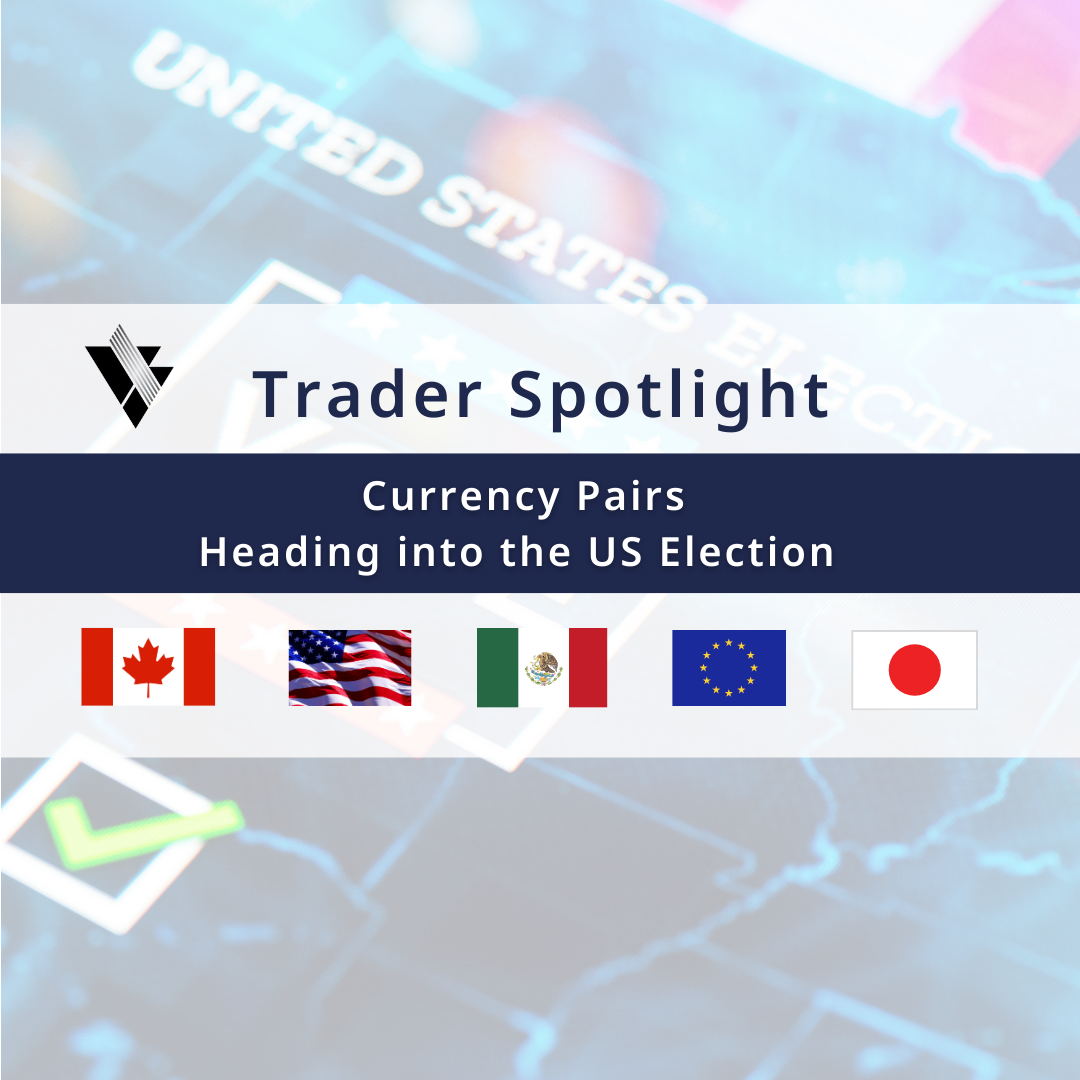
Regardless of your political affiliation, we can agree that some key economic indicators will impact currency exchange for Canadian businesses and individuals.
In October, we have the Bank of Canada Interest rate announcement and Monetary Policy Report on October 23rd, which most hope will lead to another decrease in the overnight rate, which will decrease commercial bank lending rates. This announcement comes just before the US Presidential Election scheduled for November 5th.
Volatility will be a keyword in financial markets leading up to the US Election, as macroeconomic uncertainty will be felt both before and after the election. Given that some states may have delays of up to a week or more with hand counting, this volatility will continue well past election day.
What should a business or individual do to help mitigate some of the volatility? We spoke to Steve Brown, a Senior VBCE Trader with over 25 years of experience, to discuss some helpful strategies for common currency pairs during these uncertain times. We asked Steve how each currency has been performing this year, to share any recent volatility, and his opinion on expectations on the impact on the currency pair after the US election. Steve shares his thoughts on each of the common pairs shared below:
MXN/CAD
Regarding the impact of the pairing with the peso, Steve shares, “Over the past two months, the MXNCAD rate has been holding near 2-year lows (Canadian dollar strong / peso weak). I would not expect much deviation in this currency pairing due to the election, as the USD side of the equation would likely affect both currencies equally.”
USD/CAD
We asked Steve about our neighbour to the south and what to expect as we close in on the election; Steve’s view on the pairing was that “The USDCAD rate has been exceptionally volatile these past three months. In early August, USDCAD climbed towards a 4-year high @ 1.3946, only to fall to 1.3419 (7-month low) in late September. The pairing has since climbed back towards 2.5-month highs @ 1.3837. Once the uncertainties surrounding the election have passed, I expect the USD to broadly weaken. There is a lagged effect with regard to government policy. It would likely take more than a year for any significant policy change to be enacted. Trump has threatened to sharply weaken the USD if he wins, but his tariff policies would be inflationary, which could lead to a stronger USD. A Harris win would likely result in a continuation of the broader USD downtrend, which has been in place for much of this year. Between April and October, the USD trade-weighted index fell 6% from near 1.5-year highs to a 2.5-year low.”
CAD / EUR
We wanted to know if there was any expected volatility from the European markets; Steve shared, “The EURCAD rate has climbed from near 1-year lows up towards 3.5-year highs this year. Trading in recent months has been flat within a 1.4900 – 1.5200 range. Broad-based USD weakness, along with interest rate cuts in Canada, has benefitted the EUR these past few months. I expect this pairing to remain relatively flat after the U.S. election.”
CAD/JPN
Steve supports many businesses trading between Canada and Japan, so we were curious about his thoughts on this pairing as we round out our review. Steve shared, “The JPYCAD rate had declined the first half of 2024, falling towards a 33-year low in early July. The trend abruptly changed as the Bank of Japan adopted a less dovish monetary policy and raised interest rates, while the Bank of Canada and the U.S. Fed lowered their interest rates and committed to further rate cuts over the next two years. The JPYCAD rate climbed as much as 16% towards a 1.5-year high before falling back to a 2-month low this week. Once the election uncertainties have passed, I would expect the JPY to broadly strengthen.”
Steve brings a wealth of experience to his clients, and his comments above on common pairing share his expertise as he watches the market for them.Learn more about Steve in our Trader Profile. In the profile, Steve shares how he got into the profession, and what industries and typical clients he supports.
At VBCE, we hear our clients' concerns as we head into volatility. Here are some ways to balance uncertainty that we see clients taking advantage of now as we head into the end of the year:
Hedging
Hedging is a strategy for reducing the risk of adverse price movements in the forex market. As we head into the end of the year, this is a top strategy for identifying risk and volatility. We commonly see this in companies that use this strategy to engage in forward contracts.
Forward Contract
A forward contract is an agreement to buy or sell a currency at a future date at a predetermined exchange rate. By locking in at today’s exchange rate, for example, the company doesn’t gain if the currency's value goes up, but it will be protected from losses if its value goes down. We see this commonly in companies working with businesses in countries with more volatile markets.
Pre-purchasing currency
Sometimes, a company or individual may be on an installment plan to pay an invoice or contract. In this case, you can decide whether to take advantage of the current rate and pre-purchase currency and hold it in your foreign currency account until it’s needed later. This may be done to plan for large software purchases, foreign home or mortgage payments, tuition payments, or holiday currency needs this winter.
If you have questions about the best option for you or your business, please call us and ask for an FX Trader to discuss the options based on your unique needs.